Top:

Tasty Bite!
An edible fall flower, Hollyhock, with stamen removed and filled with: Saffron Risotto, Butternut Squash, topped with Sprouted Black Lentils and Micro Leeks

Sunday, June 27, 2010

Smoothies Vs. Juices series.

Alright, now on to the bonus installment of

our Smoothies Vs. Juices series.


(from Kevin Gianni, The Renegade Health Show)


What is better for cleansing and removing toxins:


An all smoothie cleanse or a juice fast?


To start, the premise of cleansing is to allow

your body to heal itself and remove toxins

naturally.


So first off, both smoothies and juices, as long

as they're organic (and even if they're not),

are both very effective for cleansing on the

short term. (Let's say short term is 3-10 days.)


Why?


Because they give your body a break from the

more difficult foods to digest.


It's about what you leave out of your diet

that is most important.


So when it comes to cleansing, they both do

work.


I prefer a smoothie cleanse (like the one we

have in the Raw Food Challenge) for the simple

fact that you can do it for longer.


I'm not a fan of long term juice fasting and

in some cases long term juice feasting.


First off it's an irregular eating pattern, so

this can create disordered eating.


I know plenty of people who juice fast about

once a month, but binge the rest of the time.


As you know this is extremely unhealthy for

your metabolism.


It seems like they use juice fasting or juice

feasting as a traditional "diet" or as a

punishment for being bad, or to release the

"toxins" they have accumulated in the last

few weeks.


When you do a smoothie cleanse, you are much

closer to eating real food so it doesn't cause

as many disordered eating patterns AND you're

getting much more calories.


Remember, we can't subscribe to the calorie

restriction diet, until we know exactly what

it is. It does NOT mean we are supposed to

eat less calories than our body needs.


It means that we're to be smart about our

portion sizes. The scientists in these studies

"restrict" the calories of the animals. They

don't starve them. "Restriction" only means

there is enough food, but not too much.


Anyway, with smoothies your chances of getting

more calories are increased dramatically so

you're able to maintain the cleanse longer.


On a juice fast, with little apple or carrot

juice, you'd be lucky to get 500 calories

a day. With a smoothie cleanse you can get

upwards of 2000-2500.


And here's what's great... is that since many

of the nutrients in the smoothie cleanse are

simple sugars, vitamins and minerals, your

body will start to cleanse and detoxify naturally.


This doesn't mean a juice fast isn't good.


We just did one in Costa Rica.


And if you're medically instructed to do one,

don't listen to me! :-)


I just prefet the smoothie cleanse for the

majority of people's needs. Which is to get

a litte more energy, maybe lose some weight

and to jump start their healthy diet.


One last thing on a smoothie cleanse vs. juice

fast...


For weight loss, I think a smoothie cleanse

is better as well.


I think creating long term good eating habits

is best overall, but for the short term smoothie

take the cake (he he)...


Why?


Because you can lose weight more gradually.


In all my work as a trainer and health coash,

I've seen many diets and how they work with

my clients.


First and foremost, if you lose weight too

fast (with very few exceptions) you're poised

to gain it back and more.


A juice fast will cause to you lose a lost of

weight fast and when you're done, most people

will gain it back and more in a short period

of time.


I lost 9 pounds on our Costa Rica fast (I really

didn't care to lose any!).


But it was back in no time.


For me that was a plus, because I didn't want

to be so thin, but I didn't try to gain the

weight back. It just came back quickly.


So imagine if you were trying to lose weight,

you did, then you gained it right back in a

short time like that. (Plus more)


Not very comforting.


With smoothies, at least you can give your

body some time to adjust and lose weight a

little more gradually.


It still may be fast, but your chances of

creating a healthy habit with something that

you can maintain, such as a smoothie every

day, is much higher than with juices.


I'm sure there will be plenty of opinions

and thoughts about this and I welcome them.


Just remember the most effective things to

do for cleansing and detoxifying is to remove

toxins from your diet in the first place.


Your body will clear up some of the rest

when you eat clean.


So these arguments are maybe even a little too

detailed than anyone needs.


But it's fun to explain and maybe it will help

you decide which way is best for you!

Smoothies Vs. Juices... Let's rumble. :-)

(From Kev Gianni, Renigade Health Show)

Smoothies Vs. Juices... Let's rumble. :-)

The debate is a hot topic and it covers these
important issues...

1. Oxidation
2. Fiber
3. Sugar Content
4. Available Nutrients
5. Ease of Making them.

I'll run over three points now and two more
tomorrow.

(I do need to start by saying that we drink both,
but for different reasons.)

Number 1: Oxidation

It's said that high speed blenders can oxidize
your nutrients so that when you drink a smoothie
you won't get the health benefit of it.

This is why you should drink juices instead.

This is false.

Victoria Boutenko did a study using potatoes in
a blender and in a juicer and found that the
potatoes in a blender oxidized much more SLOWLY
than the potato juice.

Fiber actually protects the smoothie from
oxidizing quickly.

Juices should be consumed right after you make
them for the highest nutrient profile.

Twin gear juicers like the Tribest are best for
slowing the oxidizing process when you juice.

(We sell these in the Renegade Health store)

So the bottom line is this...

Smoothies oxidize slower, which means you will
be able to preserve more nutrients for longer.

For oxidation, we like smoothies best.

Number 2: Fiber

Don't we need fiber to prevent heart disease?

Why would we take the fiber out when we make a
juice?

These are good questions.

First off, we do need fiber... but if we're
eating a high raw diet we're getting plenty
of fiber. Your body won't miss the fiber from
the juice.

Why take the fiber out of the juice?

For fast absorption (and maximum) of the
nutrients.

A juice to me is like a power-packed supplement
to your regular healthy diet.

For fiber, the smoothie has more, but the juice
has a different purpose.

Number 3: Sugar Content

For sugar content, if you're using fruits and
sweet vegetables for your juices and smoothies
you're going to get sugar.

Most people can deal with moderate amounts of
sugar in their diet for an extended period of
time. (Higher sugar for shorter periods)

Because there is fiber in your smoothie, your
body will absorb the sugar slower. This is
good for your pancreas.

When you juice fruit, you take away the fiber
and this can cause your pancreas to struggle
to regulate your blood sugar.

For this reason, I recommend smoothies with
sweet fruits and veggies and juices with greens
and low glycemic fruits like lemons and limes.

This way you can enjoy your fruits without
blood sugar spikes and enjoy a nice, clean
green juice!

Hope this helps clear some things up for you!

(From Kev Gianni, Renigade Health Show)


~~~~~~~~~~~~~~~~~~~~~~~~~~~~~~~~~~~~~~~
Val Rae Jacobson, Living Foods Chef, Kitchen Coach & Educator
To schedule a live meal delivery, private consultation or group demo, please contact me:
816-364-6922

For recipes from my Demo and Dine Live Programs, please visit my blog.
You can Google: "What's Not Cooking at Val's"

For a catalog of the world's finest cutlery, go to:
cutco.com. Please use Rep# 33142656.

For an alternative food distribution system that provides organic produce (local, family-farmed when available) go to:
Use "Trader St. Joe's" as the discount code to receive $5-off your first order.


Monday, May 10, 2010

A Healing Foods Diet is Delicious!

Cilantro Chelation Pesto

Heavy metal poisoning is rampant. It is a major cause of hormonal imbalances, cancer, thyroid problems, neurological disturbances, learning problems, depression, food allergies, parasites, etc. etc. This is a great recipe that is not only easy to make but also really yummy, and it tells you how to remove heavy metals from the body!

Cilantro is truly a healing food. One friend suffering from high blood pressure due to mercury poisoning had her blood pressure return to normal after eating two teaspoons of this pesto daily for only a week. So whether you need to detoxify heavy metals from your body or just wish to use it as a preventative measure, 2 teaspoons a day is all you need to take. This pesto has now become a regular in my diet. Enjoy!

Cilantro Chelation Pesto

4 cloves garlic
1/3 cup Brazil nuts (selenium)
1/3 cup sunflower seeds (cysteine)
1/3 cup pumpkin seeds (zinc, magnesium)
2 cups packed fresh cilantro (coriander, Chinese parsley) (vitamin A)
2/3 cup flaxseed oil
4 tablespoons lemon juice (vitamin C)
2 tsp dulse powder
Sea salt to taste

Process the cilantro and flaxseed oil in a blender until the coriander is chopped. Add the garlic, nuts and seeds, dulse and lemon juice and mix until the mixture is finely blended into a paste. Add a pinch to sea salt to taste and blend again. Store in dark glass jars if possible. It freezes well, so purchase cilantro in season and fill enough jars to last through the year.

Cilantro has been proven to chelate toxic metals from our bodies in a relatively short period of time. Combined with the benefits of the other ingredients, this recipe is a powerful tissue cleanser.

Two teaspoons of this pesto daily for three weeks is purportedly enough to increase the urinary excretion of mercury, lead, and aluminum, thus effectively removing these toxic metals from our bodies. We can consider doing this cleanse for three weeks at least once a year. The pesto is delicious on toast, baked potatoes, and pasta.

*****
Courtesy of Nance / PLANETNEWS


Eat While Detoxing Your Body!

http://www.envirodocs.com/detox_food.htm

© By Lena Sanchez

A delightful healthy and tasty remedy to our environmental polluted bodies. I didn't discover it but I strongly approve of Dr. Omura's findings. How great is it that you can eat and detox at the same time?

Dr. Omura said he discovered, almost by accident, that the leaves of the coriander plant can accelerate the excretion of mercury, lead and aluminum from the body. He had been treating several patients for an eye infection called trachoma (granular conjunctivitis), which is caused by the micro-organism Chlamydia trachomatis. Following the standard treatment with antibiotics, Dr. Omura found that the patients' symptoms would clear up initially, then recur within a few months. He experienced similar difficulties in treating viral-related problems like Herpes Simplex types I & II and Cytomegalovirus infections.

After taking a closer look, Dr. Omura found these organisms seemed to hide and flourish in areas of the body where there were concentrations of heavy metals like mercury, lead, and aluminium. Somehow the organisms were able to use the toxic metals to protect themselves from the antibiotics.

It just so happens that while he was testing for these toxic metals, Dr. Omura noticed that mercury levels in the urine increased after one consumed a healthy serving of Vietnamese soup. The soup contained Chinese parsley, or as it is better known in this country, cilantro. (Some of you may also know it as coriander, since it comes from the leaves of the coriander plant.)

Further testing revealed that eating cilantro also increased the urinary excretion of lead and aluminum. And when cilantro was used concurrently with the antibiotics or natural antiviral agents and/or fatty acids like EPA with DHA, the above infections could be eliminated for good. ...

Dr. Omura has made a remarkable discovery. He's found a novel technique, which greatly increases our ability to clear up recurring infections, both viral and bacterial. And, perhaps more exciting, he's discovered an inexpensive, easy way to remove (or "chelate") toxic metals from the nervous system and body tissues-one that anyone can use.

Great News for Amalgam Sufferers

Cilantro Pesto

1 clove garlic
cup almonds, cashews, or other nuts
1 cup packed fresh cilantro leaves
2 tablespoons lemon juice
6 tablespoons olive oil

Put the cilantro and olive oil in blender and process until the cilantro is chopped. Add the rest of the ingredients and process to a lumpy paste. (You may need to add a touch of hot water and scrape the sides of the blender.) You can change the consistency by altering the amount of olive oil and lemon juice, but keep the 3:1 ratio of oil to juice. (It freezes well, so you can make several batches at once.)

Can you imagine eating and detoxing? Yes by adding cilantro to your foods that's exactly what happens!

Go in health!
Lena

-----
Lena Sanchez a retired Medical office nurse/administrator & a health and business consultant
http://www.envirodocs.com/experience_and_experiences.htm

Larry Morningstar
Health Issues
http://www.rawfoodinfo.com/articles/art_cilantroremheavymetals.html

Sunday, May 9, 2010

Sweet Sun-Breads and Un-Cookies


Un-Cookies with Fresh Peaches!
It's June and the peaches from Fresh Connect are divine!

I made this un-cookie recipe to compliment their flavor and give a "peach-pie" taste- sensation to my favorite family members. If you have an Excalibur dehydrator, you can put the buckwheat cookie "dough" in a pie plate and make a crust (dehydrate at 110 degrees for 2 hours or until firm to the touch.) Fill with slices of fresh or marinated peaches*, sprinkle with nutmeg and cinnamon and orange juice return to the dehydrator to desired "done-ness" or serve fresh.

If you only have a few peaches, or if you have a Nessco dehydrator like mine, make un-cookies in the shape of peach slices and top each cookie with a small pile of sliced fresh peaches.
*Marinated Peaches (stay gooey-good for days and days)
For a more traditional "cooked" flavor, marinate the peach slices in cinnamon and orange juice a a splash of grade B maple syrup in a glass container in the fridge. Toss to coat the peaches occasionally. Use these "wilted" peaches as a topping or filling. You can also use some Cashew Cream "frosting" to "glue" the peaches to the cookies when serving. If using the marinated peaches, add some of the "syrup" formed by marinating the peaches to the frosting recipe. (See below)

I also made an apple-cinnamon-banana sun-bread at the same time. The ingredients complement each other and it saves a wash-up. Sun-breads and un-cookies can be frozen (and thawed in the dehydrator) for longer shelf-life. Be sure to remove some when they are still sticky-moist to reserve for later use.

Buckwheat Grout Un-cookies (or pie crust for fruit pie)
You will need a food processor fitted with an S-blade and a dehydrator with temperature settings below 110 degrees.

Ingredients:
  • 2 cups dry-measure buckwheat grouts (sprouted 3 days)
  • 1/2 cup dry-measure raw pumpkin seeds (soaked 1 hour or sprouted)
  • 1/2 cup raw honey
  • 1 apple cored and chopped
  • 1/4 cup ground golden flax seed (optional)
  • 1 inch fresh grated ginger
  • 2 whole vanilla beans, scraped (or 2 tsp. vanilla powder)
  • 1/2 nutmeg corn, grated
  • 1 tsp allspice and/or cinnamon
  • 1/2 cup soaked flame raisins (plus more for garnish, if making un-cookies)
  • 1/2 tsp almond extract
  • very small pinch of cayenne
  • 1/2 tsp Himalayan pink salt
  • clean source water
  • 1/2 to 2/3 cup raw walnut or sunflower oil
  • rose water (optional)
  • 2 TBS heather or lavender flowers and leaves chopped (optional)
  • Garnish with fresh mint leaves (optional)
Instructions:
Rinse the buckwheat grouts and seeds and discard the liquid. Seeds can be wet, just do not include the soaking water. Place all ingredients in the food processor, adding oil and herbs last. Process, scraping down the sides often and drizzling the oil as the processor runs until a smooth batter forms. Adjust for salt or sweet by adding more honey or sea salt. Remember the flavors will intensify with dehydration.

Spoon onto Teflex sheets or press a thin layer into an oiled pie plate. (Coconut, sunflower or walnut oil work well). Brush to top of the pie crust with oil. (You may have to dehydrate for an hour or so before you can brush the pie crust.) If you are planning to serve the entire pie immediately, you can skip this step. The oil creates a barrier that helps keep the peach juices from re-hydrating the crust, causing it to fall apart. If making the un-cookies, garnish the tops of each with soaked raisins. Tapp them in a bit to keep them soft after dehydrating. Dehydrate at 110 degrees until desired crispness is achieved. Flip cookies once.

If you like a cobler-like "crumbly top" for your peach pie, grind Brazil nuts in a spice mill with a pinch of living rock salt and the "pie" spices. Sprinkle this mixture over the top of the peaches. You can also make this topping in advance and dehydrate to a dryer, more crumbly consistency. Store in the fridge until ready to use.

If you want to save some for later use, take the un-cookies out of the dehydrator while still soft and gooey in the middle, freeze or refrigerate on parchment. Reheat when ready to use by placing in the dehydrator at 110 degrees.

Banana-nut Sun-bread Recipe
You will need a food processor fitted with an S-blade and a dehydrator with temperature settings below 110 degrees.

Ingredients:
  • 2 cups dry-measure buckwheat grouts (sprouted 3 days)
  • 1/2 cup raw pumpkin seeds or sprouted sunflower seeds (soaked one hour or sprouted)
  • 1/2 cup raw honey
  • 1 apple cored and chopped
  • 1 or 2 ripe bananas (the more banana you add the more moist the bread will be)
  • 1/2-inch grated ginger
  • 2 whole vanilla beans, scraped (or 2 tsp. vanilla powder)
  • 1/2 nutmeg corn, grated
  • 1/2 cup soaked raisins or dates
  • 1/2 tsp almond extract
  • very small pinch of cayenne pepper
  • 1/2 tsp Himalayan pink salt
  • clean source water
  • 1/2 to 2/3 cup raw walnut or sunflower oil
  • rose water (optional)
  • 2 TBS heather or lavender flowers and leaves chopped (optional)
  • 1 to 1 1/2 cup of pecans and/or walnuts (soaked, rinsed and chopped.)
Instructions:
Rinse the buckwheat grouts and seeds and discard the liquid. Seeds can be wet, just do not include the soaking water.

Place all ingredients (except the nuts) in the food processor, adding oil and herbs last. Process, scraping down the sides often and drizzling the oil as the processor runs, until a smooth batter forms. Add nuts, pulse to blend and chop or add last and stir in with a spoon.

Spoon batter onto Teflex sheets as individual serving sizes or form manna-sized loaves. Dehydrate at 110 degrees until desired crispness is achieved. Flip once. If you want to save some for later use, take them out while still soft and gooey in the middle, freeze or refrigerate on parchment. Reheat when ready to use by placing in the dehydrator at 110 degrees.

Raw Cashew Cream Frosting
Ingredients:
  • 1 cup un-roasted whole cashews (soaked at least one hour)
  • 1/3 cup of fresh squeezed orange juice
  • 1 tsp of orange zest
  • pinch of fresh-ground nutmeg
  • pinch of Himalayan pink salt (or other high-quality living salt)
  • 1/2 cup raw honey
  • 1/2 tsp of rose water (optional)
  • 1 TBS unprocessed arrow root powder
( If using the marinated peaches, add some of the "syrup" formed by marinating the peaches to the frosting recipe.)

Instructions:
In food processor fitted with an S-blade, process until creamy. Refrigerate until ready to use.

TIP: Make tea before you toss small, flavorful, scraps into the compost. If using the herbs and ginger, take the coarse parts of the ginger peel, the lavender and/or mint stems and vanilla bean pod (after scraping) to make a light and lovely, mood-enhancing, cleansing tea. Place "scraps" in a stainless steel pan with clean source water, bring to a boil, let steep for 10 minutes or so. Strain into a cup. Sweeten with honey, as desired.

Keep a lot of empty space around your dehydrator for best results.


Friday, April 23, 2010

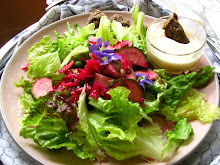
Spring Salad


A sweet and a lemony dressing accompany this lunch:
1) Lemon-Garlic Tahini for dipping the zucchini sun-breads and
2) Sweet beet and onion dressing over the John Goode's baby romaine.
Top it off with fresh-picked wild violets. Use some of the smaller lighter-green new leaves from the violets as part of your mix for salad greens. Yum!
All ingredients are local, when available, and ALWAYS organic or home-grown using organic methods.

Lemon Garlic Tahini Dip:
Ingredients:
  • juice of one lemon
  • 1 tsp of Cooper's local clover honey*
  • 1/8 tsp Himalayan pink salt*
  • 1 and 1/2 cups of hulled organic sesame seeds*
  • 2-3 cloves of garlic, to taste
  • clean source water for soaking seeds and as needed (up to 1/4 cup)
* Available on the shelf at Kovac's North in the produce section, 2201 Frederick Ave. St. Joseph, MO 64507.
John Goode's gorgous greens available through freshconnectkc.com

Instructions:
Soak sesame seeds 4 hours at room temp or overnight in fridge. Drain, rinse and allow to rest, wet, for a minimum of 4 hours in the dark. (One method is to use a dish or crock that does not allow light to pass through. Cover the dish with a plate as it's lid. Another method is to use a glass jar and place it inside a double layered brown grocery bag.) Expose to sun-light for 10 to 15 minutes, optional. Rinse one more time before adding to recipe.

Add soaked seeds with all other ingredients to the food processor or Vitamix. Only use water, if needed. Blend until smooth. Chill or store in fridge. Use as a dip for sun-breads and living seed crackers; To use as a salad dressing, add raw or toasted sesame oil and more citrus juice (lemon, orange or lime are all good!) Also used as an ingredient in hummus.

Sweet-Beet Dressing/Marinade
Ingredients:
  • 1 cup Raw Oil of Choice (Safflower, Sunflower, Raw Sesame, Walnut, Grape-seed, Pumpkin Seed, Extra Virgin Olive are all good raw bases)
  • 1/2 cup raw apple cider vinegar
  • 1/4 cup grade B maple syrup
  • 1/2 large yellow onion, dices
  • 1-2 cloves crushed garlic, to taste
  • about 1/4 cup of diced beets = center cut of one small beet
  • a pinch of Himalayan sea salt (optional) -some oils, like olive oil, do not require extra salt
  • fresh garden herbs

Instructions:
Making this dressing the day before you use it mellows the flavors and results in extra bright colors.
TIP
Instead of peeling the beet, just carve a square out of the middle and use the outer pieces (peel in-tact) to run through the juicer. Add the juice to the dressing. Or, just drink it. You can also add other veggies to the juicer to make a full glass of veggie juice (I like combining celery, apples, sweet-potatoes or the stems from kale or chard with the beet. You will be surprised how a little beet-juice goes a long way!)

Add the ingredients to a glass jar, shake it and refrigerate until ready to use. The yellow onion will turn bright pink and translucent. All other veggies and herbs to your liking. Zuchini, cucumber, diced carrots, spring radishes, sweet corn and pumpkin seeds are all good choices.


Warm the sun bread in 75+ degrees in the sun under a bug-screen or pop them in the dehydrator at 105 degrees for 10 to 15 minutes. Serve with chilled Tahni dip.
To assemble the salad: harvest baby romaine, wash and pat dry the leaves. Put tiwce as much on your plate as you normally would. Toss or top with dressing, edible flowers, freshly-shucked peas and anything else young and green and cute you can find!

Saturday, March 13, 2010

Vanilla Bean Banana Ice "Cream"


We all agree, once you have this, you will never want dairy ice-cream again.


For "sorbet" use the ice "cream" recipe below and omit the bananas and sunflower seeds. Add any fruit; fresh or frozen or a combination of fresh and frozen.

You will need a high-speed blender. This recipe alone makes the price of a Vita-mix worth it!

Two to Four Servings
Ingredients:
  • 1/2 cup of clean source water or coconut water
  • 1/2 tsp Himalayan pink salt
  • 2 whole vanilla beans
  • 1 cup activated sunflower seeds
  • 6 clean source ice cubes
  • 3 whole bananas (peeled and frozen)
  • 1/3 cup of raw honey (optional)
  • pinch of ground cardamon (optional)
  • 1/2 to 1 cap-full of almond extract (optional)
Step one (optional): Activating the sunflower seeds is optional. However, it results in a creamier dreamier ice "cream." Activate to your preference, do not allow to sprout.

Step Two: It is important to start with softened seeds. To soften, soak in clean source water for a minimum of 20 minutes, drain and rinse before adding to blender. Put water, salt, seeds, and vanilla beans in first. Blend until vanilla beans are broken up.

Step Three: Add other ingredients. Use the auger to push frozen fruit and ice cubes into the blades while they are turning on low speed. Switch to high at the end. Do not over blend. It will heat the mixture. If it does, no biggy. You will just need to chill it longer, especially if you are making a layered dessert with several flavors. (See Neapolitans, below). Pour into glasses or ceramic bowls and chill in the freezer to desired consistency. Or drink as a thick mylk shake.

To make Vanilla Pear ice "cream", substitute frozen pear slices for bananas. Use 1/2 a pear per person (So far, this is every body's favorite! It's just hard for me to sacrifice the pears because they are so good to just EAT. I always seem to have plenty of extra bananas.)
To make Mocha ice "cream," use the recipe above and add 1 tsp of carob (or highest quality raw cacao powder) and 1 tsp of fine ground light roast coffee.

For a "Chunky Monkey" add chilled organic peanut butter from New Mexico and fresh or frozen bananas at the end and pulse so it's not totally blended in. This is especially good in a cocoa or carob ice "cream."

I like red bananas best, but any organic banana will do! I also like to add Mystic Tonic's, Vanilla Blend when I feel like I need extra boost. It has maca, hemp seeds, cordecepts and EFAs from natural sources. It is the only protein powder I will use.

Peanut butter from New Mexico is free from molds and pesticides. It is the only peanut butter I will use.


Add frozen aronia berries, blue berries, raspberries, blackberries, peaches, apples, kiwi, lemon, persimmons, fennel, oranges, pineapple, fresh pumpkin or strawberries for variety.

For basic
fudge sauce:
Mix, in this order:
  • 2 TBs warm, but not boiling, water
  • 3 TBs Carob powder or highest quality raw cocoa powder
  • 1 TB raw honey
  • 2 TBs grade B maple syrup
  • scant pinch of Himalayan pink salt (optional)
Sometimes we make Neapolitans:
Make a full blender of vanilla (with pear or bananas). Pour 1/3 into chilled low-ball glasses. Place in the freezer while you add strawberries to the blender. Blend. Pour 1/3 on top of the vanilla. Place in the freezer while you add carob powder to the remaining third and pour onto the top. The last layer will be "loose" so you might add a little more salt and ice if you plan to serve right away. The result is a banded dessert that would impress even the most discerning mother-in-law! Garnish with a whole fresh strawberry on each glass.

ENJOY!


Cooked Foods: Hummus


Sprouted Garbanzo Bean Hummus
Sprouting the garbanzo beans increases nutrient content and improves flavor. I have not arrived at a raw hummus that is as satisfying, so I'm keeping this as one of my cooked foods. This is true of most beans. I sprout, then cook them. Raw beans are difficult to digest.

I always eat cooked foods, including hummus, with plenty of fresh vegetables to aid in digestion. Sometimes, I'll eat kraut and/or a digestive enzyme supplement as well.

The important thing is to ENJOY the cooked foods!
Endorphins are Everything: Mood-enhancing, immune supporting and energizing! It's simple to make sure you get enough endorphins:
Step one: ENJOY what you eat, and also what you: do, think, say, have.. be gratitude.
Step two: Repeat step one. Celebrate that you can enjoy foods, cooked and raw, and you can start now. That's it.
Step three: "But what about this, but what about that, but..." says your busy mind. Watch that go past and repeat step one. some coked foods in the diet have proven to increase vitality in most clients I have consulted with. I recommend that you periodically, go 100% raw for a few weeks or days --whatever feels great to YOU.

In the winter months, I choose to eat an average of 5 to 7 cooked foods a week, less often in the spring, summer and fall. You will find your balance by monitoring how you feel as you incorporate fewer, or more cooked foods into your life.

Hummus is an ancient middle-eastern food tradition with a long history of health benefits to peoples who use it as a regular protein source. The traditional recipes usually include sesame seed paste, called tahini. I prefer to leave it out or make fresh tahini and stir it into the hummus prior to serving, as raw sesame seeds go rancid quickly and can spoil the batch. However, I use sesame seeds in the same meal as garbanzo beans in the form of a salad dressing or topping. The combination of sesame and garbanzo makes a "complete protein" with all the detectable amino acids our bodies need. Ancient cultures didn't have laboratory testing. How did they know to combine these two things? My guess is, they were in tune with their natural selves.

I have found that prepared tahini in a jar is bitter and contains sulphates or other preservatives that create free-radical damage in our bodies. However, adding freshly prepared home-made tahini* when serving the hummus is an excellent idea.
*See Raw Tahini Recipe below. I use a small amount of honey in these recipes because Mediterranean lemons are much sweeter than North American ones we buy. The honey is intended to bring balance, but should not be a dominant flavor. Adjust amounts to your taste and to adjust for the sweet or sourness of your lemons. You can also use 1/2 fresh-squeezed lemon and 1/2 fresh squeezed orange to balance.

Hummus Recipe:
You will need a food processor or high-speed blender. (I prefer the food processor to make a thicker consistency.)

Ingredients:
4 cups of dried garbanzo beans
8 cups of clean source water, plus more for rinsing and water changes
3 to 5 bay leaves (optional)
juice of 2 large lemons or 3 small ones
1 to 2 tsp of ground cumin
1 TBs raw honey
1 to 2 tsp Himalayan pink salt or other high quality unprocessed mineral salt
2 -4 cloves or garlic, crushed
1/2 cup raw tahini (if using) - recipe below
Extra virgin, cold-pressed olive oil (1 to 1 1/2 cups)

All ingredients are organically grown and sustainably harvested.

Hummus Instructions:
Step one (optional): Sprouting is optional. You can make hummus by cooking dried garbanzos right out of the container. Sprouting increases the nutrient value and the yield and results in a creamer, dreamier hummus!
There's no one right way to sprout the garbanzos. Do it to your liking. There are plenty of differences in the sprouting guides I have reviewed. Sprout to your liking. Just soaking until they double in size is good enough. I keep some under water in my fridge on the ready. They seem to keep well for at least 4 days, if I change the water each day.

Here's my preferred method:
  • Soak them over night in water;
  • Change the water the next day;
  • Leave them wet at room temp in a ceramic mixing bowl, covered, away from light, all day and overnight the second night;
  • Rinse and change to a clean bowl, place in fresh water to cover by 2 inches and put outside in the sun for 4 to 8 hours. ( If it's a hot day, above 70 degrees air temp) change the water at least one time mid-day and place the ceramic bowl in a large stainless bowl filled with ice for the second half of the sunning. Cover with a bug screen or mesh.
  • Wash one more time before transferring to the cooking pot with fresh water to cover.
To cook:
  • Bring pot to a boil, add bay leaves, reduce to a simmer. Monitor the water level and add more warm water form a tea kettle, as needed. You may also choose to use a pressure-cooker. (Be sure all cooking pots are highest quality stainless steel. Such as SaladMaster or other "waterless cookware" that is NOT bonded to aluminum.)
  • When garbanzo beans are softened to your liking, salt the water and allow the cooking water and beans to cool to room temp (or still warm, but not too hot to handle). Reserve liquid.
  • Remove bay leaves and discard. Take some beans out for garnishing, wraps and salad toppings. Refrigerate. Store in a glass or ceramic container.
To process:
Add batches of cooked beans to a food processor fitted with an S-blade along with the lemon juice, garlic, honey, cumin and tahini, if using. Add cooking water in 1/4-cup increments as the mixture is blending. Wait until the mixture is smooth, then drizzle the oil in as the processor is turning. Adjust for salt AFTER adding the oil.

To serve:
Serve room at temp, or store refrigerated. Garnish with more oil, and spices or herbs of choice: ground paprika, sumac (pictured), cumin, or cardamon; fresh cilantro, scallions, diced red onion, shallots, chives, basil, sage or mint. Traditionally, Egyptian version will include a topping of oil with pine nuts and sprinkle of cayenne or ground chillies, cumin and sumac. Easy on the cayenne or ground chilies. They will increase in heat as they become more saturated with the moisture from the hummus. Also great with diced Sun-dried tomatoes and olives.

We eat this hummus with living seed crackers or savory sun breads or dip slices of: cucumbers, zucchini, broccoli stem, snap peas, pepper strips, celery or carrots Left-overs make a filling for hollyhock-leaf, romaine, cabbage-leaf or chard-leaf wraps with sprouts, marinated or shredded veggies and whole garbanzo beans. Hummus wraps are excellent to serve with Tzatziki sauce (see recipe below)

Beyond Basic:
Be creative. Check ingredients in Middle-Eastern recipes to get ideas for flavored hummus.
  • Add sun-dried tomatoes and roasted red peppers to the food processor for a hummus rich in flavanoids, selenium and licopene.
  • Increase the garlic and add soaked dried hot peppers for a spicy hummus high in anti-microbial properties.
  • Experiment with curries and fresh herbs. (Napoleon Basil & Hand-harvested Mendocino Sea-Palm Fronds were added to this magic hummus, above.)
  • Adding an entire hand-full of fresh basil and 1/2 cup of soaked walnuts makes a great sandwich spread!
  • Add an half an onion, half a zucchini or 1/2 a cucumber to the processor in place of cooing water to increase the raw content of the food.
Raw Tahini Recipe:
I recommend making this in small batches and using the left-over to make dressing. It has a short shelf-life. But it's not difficult and it is definitely worth making if you want the traditional middle eastern hummus flavor.
  • 2 cups of raw sesame seeds
  • 1/4 cup RAW sesame oil
  • juice of 2 lemons
  • 1 tsp clover honey (optional)
  • 3-5 cloves of garlic

Soak sesame seeds overnight or up to two days, refrigerated. Drain and rinse well in cheese cloth or fine sieve. Transfer to a bowl of a food processor fitted with an S-blade. Process all ingredients until a smooth paste forms. Add a little clean source water, if needed. Scrape down the sides of the bowl and process again.

Transfer to a jar or ceramic dish. Cover with more oil, to store. Or, add to salad dressing or garbanzo bean hummus recipe.

TIP: Make the tahini first, then use the processor to make the humus, saving a wash-up.

Tzatziki sauce
  • 1 large cucumber, scrubbed and peeled in stripes to remove about half of the peel.
  • Dice or chop in food processor with:
  • 1/2 white onion,
  • 2 to 5 cloves of garlic, crushed
  • 1/2 tsp ground cumin
  • juice of 1/2 or one whole a lemon, to taste (I sometimes use 1/2 lemon 1/2 orange)
  • pinch of kelp or sea salt
Transfer to a mixing bowl and stir in the "yogurt" and herbs:
  • 1/2 to 2/3 cup of goat-milk yogurt, kefer or soured cashew cream.
  • Fresh mint, chopped to your preference (optional)
  • Fresh flat-leaf parsley
You can make this recipe chunky or smooth to your preference.

Organic Resources:
Garbanzo Beans, Sesame Seeds, Himilayan Pink Salt - Trader St. Joe's at Kovac's 2201 Frederick Ave. St. Joseph, MO
Extra Virgin Olive Oil - Trader St. Joe's at Kovac's 2201 Frederick Ave. St. Joseph, MO 65407 (out of stock)
Lemons, Valencia Oranges, cucumbers, fresh veggies, garlic, Himilayan Pink Salt - freshconnectkc.com
Cucumbers, tomatoes, fresh greens, Napoleon Basil - Goode Acres Organic Farm (Weds and Weekends at the KC River Market or goodeacres.com
Sea Palm Frond and Kelp Powders - Trader St. Joe's at Kovac's 2201 Frederick Ave. St. Joseph, MO or order direct from Mendocino Sea Veggie Co. www.seaweed.net/
Goat Yogurt - need a local source! Please advise.
Raw Honey - A-Z Fresh Air Fair, 114 South 8th Street St. Joseph, MO 64501
Greek Olives - Superfooduniverse.com


Cooked Foods

One Dish Wonder!

Of Course, A High-Raw Life-Style (higher percentage of raw foods) Includes SOME Cooked Foods, Too.
The question comes up, what to choose for cooked foods? If I'm going to the trouble to cook something, I choose delicious, satisfying, healthy foods. There are some things I've tried to make raw or sprouted and have learned that I just prefer them cooked. Here are a few of my favorites:
  • Sprouted garbanzo beans (also known as chick peas);
  • Fresh pink, green and tan chicken or duck eggs (from birds and their farmers, who I know personally);
  • Sprouted quinoa;
  • Sprouted barley;
  • A variety of lentils (Dried or fermented in goat yogurt);
  • sprouted dried beans;
  • Artichokes;
  • Popcorn;
  • Potatoes (I recommend to use small heirloom varieties);
  • Occasionally, I enjoy steamed, sweated or wilted: greens, cabbage, onions, squash, broccoli, asparagus;
  • Toasted mustard seeds and coconut;
  • Or, I'll melt coconut oil inn a stainless steel pan and saute onions, celery, mushrooms, fresh herbs and/or root vegetables as toppings and condiments. These are all great raw too!
Currently, in the late winter months, I choose to eat 3 to 5 cooked foods a week as: condiments, side dishes, special treats and mid-day meals served with lot's of fresh veggies for optimal nutrient absorption. You may also choose to supplement with a digestive enzyme or eat some fermented kraut with your cooked foods to aide in metabolic processes. Whenever we eat cooked foods, our metabolic enzymes are used to digest them. This interrupts the "healing and vitality" role of our system. A healthy body can compensate with help from mircoorganisms found in fermented foods and enzymes from a reliable source. (Metabolic enzymes are your healing and vitality workers. They must stop what they are "doing" and aide your digestion and obsorption whenever you present your system with a challenge. Cooked foods are a challenge. None-the-less, cooked foods bring us pleasure. Enjoyable meals are key to health and healing! Feeling satisfied increased your endorphins and levels out your hormonal activities. So, if you percieve a raw foods life-style as "rabbit food," or attach other negative connotations to eating this way, your higher self may be telling you to incorporate cooked foods. Using one of the 80/20 "rules," eat cooked foods (20% of your meal) and raw foods (80%) whenever you feeling unsatisfied. To find a enjoyable balance, monitor how you feel after each meal. Eat cooked foods mid-day, exercise regularly and drink clean-source water in abundance.
Here are a few cooked recipes you may want to incorporate into your raw high-raw foods lifestyle!
I will post the recipes separately. Use the search window of the blog to find these and other recipes by name or ingredients. Enjoy!
  • Channa Dal Dhoka (Steamed Lentil Cakes)
  • Hummus (Garbanzo Bean Dip/Spread)
  • Frittata (Cooked Eggs with Fresh Veggie Toppings)
  • One Dish Wonder! (pictured above)
Here are foods you should never heat above 105 degrees:
  • olive, nut or seed oils
  • olives
  • seeds and nuts
  • fruits (fresh or dried)
The result is carcinogenic!

Thursday, March 11, 2010

Eggplant and Flax Veggie Burgers


Make a batch!
You'll be surprised how fast they go!
(If you are uncooking for 1 or 2 eaters, no worries, they freeze and re-heat well.)
You will need a food processor, a spice mill or clean coffee grinder and a dehydrator with temp setting or 105 degrees.

All ingredients are grown using organic practices. This recipe makes 8 to 10 patties.
Prep:
Prepare the eggplant by slicing into 1/4" slabs. Position half the slices in layers in a stainless steel strainer, salting in between each layer liberally with Himalayan pink salt or coarse ground unprocessed salt. Let stand for 15 minutes to 2 hours at room temp or overnight in the fridge.

Wash off the salt with clean source water, drain the eggplant slices to remove excess moisture.

(Use the other half of the eggplant to make marinated dehydrated eggplant slices. Add freshly sliced eggplant to olive oil infused with herbs. Use a garlic press to add the pulp of 3 or 4 garlic cloves. Add a thinly sliced lemon, if you have it. Dehydrate for 2 to 5 hours. Serve as a "topper" for the veggie burgers.) Speaking of "toppers"... While you have the extra virgin olive oil in hand, marinate some mushrooms and onions in the same mix. Add rosemary or basil, if you have it! Oh Yum. In a few hours you will have heaven. Expose to sunlight, if possible. If it's cool out (below 40 degrees, but not freezing), you can set marinating veggies out covered with a parchment paper tent. Otherwise, use a tight fitting "bug screen". (A draw-string, laundry-delicate-bag works well or an unused nylon paint strainer with the over end tucked under the dish will keep most critters out. Check and rescue anything that's still moving!

Remove the eggplant and lemons from the marinade after 1/2 hour or up to 2 hours, and transfer to the dehydrator. Set at 105 degrees. Use the flavored oil to marinate Swiss chard, Rainbow Chard (pictured here) or kale.

Measure 1/4 cup whole flax seeds, freshly grind in a spice mill or or clean coffee grinder with 1/4 tsp of course unprocessed salt.

Shred carrot or parsnip or sweet potato or all three. Use a total of 1/2 cup of shredded root vegetables in the veggie burger recipe. (Add a vinaigrette dressing and celery seed to shredded veggies and refrigerate to use as a topper for the veggie burger or side salad or serve as a slaw)

To make the veggie burger:
(Grind together the ingredients in two phases)
First add to the food processor:

  • 1/4 cup whole flax seeds, freshly ground
  • 1/2 a spicy chili pepper, seeds and pith removed
  • 1 whole mild jalapeno pepper, seeds and pith removed
  • 5 to 7 sage leaves (or 1 tsp of rubbed sage)
  • 2 TBs fresh rosemary, chopped fine
  • 3 coves of garlic, pressed
Pulse and scape down the sides, grind again until chili peppers are small bits. Then, add:
  • 2 cups or activated walnuts
  • 1/2 a medium eggplant (salted and washed)
  • 1 small onion
  • 3 to 5 sun-dried tomatoes in oil, plus 2 TBs of the oil
  • (Substitute 1/4 cup homemade ketsup)
  • 1/2 cup shredded carrot or parsnip (optional)
  • 1/2 cup fresh mushroom stems (optional)
  • 1 TBs grade B maple syrup
  • 1 or 2 tsps of maca root or carob powder to color (carob results in a very dark brown patty. Maca, a golden brown)
Scoop out burger-sized blobs of the "meat" mixture onto Teflex sheets. Use wet hands to shape and flatten each into a patty. Dehydrate for 3 to 5 hours at 105 degrees flipping once. When reheating, or just before serving, crank the temp up to 125 degrees for 5 or 8 minutes and transfer to a warm plate to serve.

Still working on the "bun." Let me know if you have a recipe for a soft raw sandwich sunbread. In the mean time, I serve the burgers with a large salad and top with marinated mushrooms, kale and onions, root vegetable slaw with optional BBQ sauce, mustard, kraut and ketsup. Didn't get a "finished" shot. Both times I have made these, it was for a group and we were too hungry to wait for pictures! Amazingly, this recipe makes 10 patties! They were so good! I'll make more and add a picture soon.